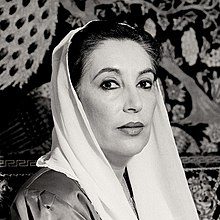
Benazir Bhutto has always been my favorite personality, even though I never had any political affiliation with her party, nor did I ever vote. When she became the Prime Minister of Pakistan, I was in my childhood and didn’t know much about whether her political tenure was good or bad. However, I always heard her name spoken with respect in my home. She was admired as a well-educated woman.
Benazir Bhutto was born on June 21, 1953, and she was martyred at the age of 53 after being shot.
Her personal life didn’t concern us much, but what inspired me deeply was how she never forgot her religious and cultural roots despite her international exposure. Even though her father promoted liberalism, she maintained her values as a Pakistani and a Muslim when she returned to Pakistan.
Her demeanor impressed me the most. She balanced firmness and politeness in her communication, adopting a strong tone when necessary while remaining graceful when the situation demanded. Despite not being fluent in the Urdu language, she upheld her cultural and traditional identity.
Benazir Bhutto was Pakistan’s first female Prime Minister, which in itself is a monumental achievement. However, what truly inspired me was not her education from Oxford University but her ability to preserve her cultural and religious identity while navigating the complexities of leadership in Pakistan.
Several books have been written about Benazir Bhutto, highlighting her life, politics, and legacy. Some notable ones include:
- “Mashriq Ki Beti”
This book narrates the story of Benazir Bhutto’s life and her journey as a leader, often referred to as “The Daughter of the East” in the Urdu language. - “Mera Lahoo”
This book reflects on the sacrifices and struggles associated with Benazir Bhutto’s life and political career. - “Meri Pyari Beti”
A collection of letters written by her father, Zulfikar Ali Bhutto, to Benazir Bhutto during his imprisonment. These letters showcase the bond between father and daughter and their shared vision for Pakistan.
Additionally, Benazir Bhutto herself authored two significant books:
- “Reconciliation: Islam, Democracy, and the West”
In this book, she discusses the challenges of reconciling Islam and democracy while addressing global misconceptions about Islam. It also outlines her vision for a harmonious relationship between the Islamic world and the West. - “Daughter of Destiny: An Autobiography”
This autobiography provides a detailed account of her personal life, struggles, and political journey, offering a glimpse into the experiences that shaped her as a leader.
These books collectively offer deep insights into Benazir Bhutto’s personal and professional life, making her an enduring figure of inspiration.
In Reconciliation: Islam, Democracy, and the West, Benazir Bhutto challenges misconceptions about Islam’s incompatibility with democracy by highlighting historical examples of Islamic principles like consultation (shura) and justice. She advocates for promoting a moderate interpretation of Islam to counter extremism, which she attributes to socio-political factors rather than religion. Bhutto critiques the “clash of civilizations” narrative, urging dialogue and understanding between the Islamic world and the West. She envisions a democratic Islamic world that respects cultural and religious values while embracing modernization. Drawing from her own experiences as a Muslim woman leader, she reflects on balancing tradition with progressive governance. Finally, she offers policy recommendations for fostering global harmony, emphasizing education, economic development, and women’s empowerment as tools to combat extremism and build a more inclusive future.
from Reconciliation: Islam, Democracy, and the West, it can be inferred that Benazir Bhutto had a deep understanding of the core values of her religion. In the book, she explains the compatibility between Islam and democracy, highlighting aspects of Islam such as shura (consultation) and justice, which align with democratic principles.
She emphasized that the true message of Islam is not extremism, but moderation and justice. This reflects her understanding of the fundamental values of her faith. Throughout her leadership, she sought to balance these religious values with her modern political ideas, promoting both Islamic values and democratic governance in Pakistan. Her ability to integrate these principles demonstrates her awareness and commitment to her religion’s core teachings while pursuing progressive political goals.
We still need well-educated and mature women like Benazir Bhutto who can advocate for the rights of others, who understand and can explain that Pakistan, as an Islamic democracy, must uphold the rights of women. These rights are already enshrined in law, but they are often not fully implemented. I pray that she rests in peace, and I ask Allah to elevate her status in the hereafter. I still remember the day of her death, December 27, 2007, because I was at my cousin’s wedding event on that day.